My lifelong friend’s book is coming out!

My dear, dear German friend Alexis’ first book is coming out. She writes fantasy books, like me!

Her debut novel, The Deathbringer, will hit German bookshelves in March/April of 2018.

The Deathbringer is the tender story of a princess…who becomes an assassin. Yeah!

She kicks ass. The book kicks ass. Everyone kicks ass! Including my publisher, who hired Alexis on my recommendation. I hope fans are as into her work as I am.

The rights will be shopped in the US soon (when the time is right).

Until then, good luck Alexis!

The Mapper Series on Paper

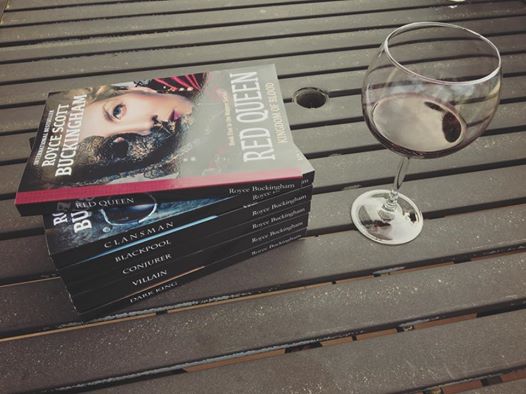
Formatting books for print is not for the faint of heart when the author focus is writing stories. It took a few months and some hair pulling. Today we celebrate with all six books in the Mapper Series available for U.S. readers in both print and Ebooks! For some back story, the series did phenomenally well in Germany when Book I: Die Karte Der Welt, hit the bestseller list. Book Two: Der Wille Des Konigs was a prequel to the first and then Book Three: Die Rubinrote Konigin followed. Learn more about the series here.

For the U.S., we decided to re-order the books  and break them down from three 700-pagers to six smaller books. We are incredibly pleased with the results. Self-publishing does have its perks.


Spark Your Writing Career with Competitions

By Royce Buckingham

My 16 year old son just earned 1st Place for his composition in the Washington State Young Composer’s Project. While I understand that this news is most exciting to my immediate family, it reminds me of how important contests were in building my writing resume and ultimately leading to my first deal.

I started by submitting short stories to contests, wrote and submitted my first novel (which is still in my desk drawer, by the way), and then moved on to screenplays. First, I chose regional contests and then expanded to national opportunities. With each new honorable mention, second place, and outright win, I gained the confidence and inspiration to continue developing my craft.

Eventually, my entry into the Academy Nicholl Fellowships earned a semifinal finish, which led to my first book sale and a movie deal with 20th Century Fox.

Here are the things I looked for when choosing which contests to enter:

Price: Most budding authors don’t have a ton of money to throw around. Make sure the cost is in line with the size and reputation of the contest.

Is the contest reputable? Find out how long its been around. Check out past winners. Research what others have said about it. Review the list of  judges.

Exposure: Make sure success in the contest will get people to take you seriously at the next level. Also, what type(s) of promotion does the contest offer, and is there a solid web and social media presence?

Feedback: You need to hear what others think about your work. Contests that include critiques by judges are extremely valuable to improve your storytelling and evaluate whether to continue developing and marketing the story you submitted or chalk it up to experience and move on to new material.


Query Letters

I’ve been writing query letters for a while now, so you’d think I have it down. Yet its important to adjust to changes in personnel, technology and industry expectations, I found this column by Gus Sambchino helpful.  Check it out!

(This column excerpted from GUIDE TO LITERARY AGENTS, from Writer’s Digest Books.)

Writing Tips from Kent Messum

Top 10 lists are all a matter of the opinion. What speaks to one person might not to another. I find them helpful, however, to see where my experiences align with others and to gain new perspective. In this list, for instance, #s 2, 3, 8, 9 and 10 resonate the most for me and are similar to my thought process and practice of writing. What speaks to you?

1. Don’t write linearly: Don’t set out to write something from beginning to end. A story is meant to be read from front to back, but not necessarily created that way. If you have an idea for writing the sixth chapter first, then start there. The epilogue can even be the first thing you put down on paper, then work your way back. Scattered chapters will eventually be filled in, and it will force you to look at the story from different angles, which may present different ideas or new approaches. You’d be surprised how well this works when a whole book starts coming together. It’s also great for getting around writer’s block.

2. Have two or more projects on the go: Speaking of writer’s block, having more than one project on the go is never a bad idea. Although focus and dedication are paramount to completing a work, sometimes you inevitably get stuck. It’s good to be able to move on to something else instead of feeling frustrated and stagnant. You don’t have to have a few big projects happening either … maybe you’re penning a novel, but also some short stories and an article or two.

3. Be your own editor: There are days where I have difficulty writing altogether, so I’ll switch to editing my stories rather than trying to create them. Never assume it is someone else’s job to fix your mistakes. Find all the errors first, and deal with them yourself. The more polished and refined your work is, the more favorably it will be received when you’re finally ready to present it.

4. Ask for (and take lots of) punishment: It is well worth finding yourself a professional writer or editor and asking/paying them to look at your work. Tell them to give you highly critical feedback with no sugarcoating. Let them go so far as to be cruel too, just so you really get the point. There is a lot of rejection and criticism involved in the publishing industry. Getting accustomed to it sooner than later is advantageous. If you want to be serious about your writing, then you’ll need to know everything wrong with your writing. Accepting and understanding the harsh realities of your shortcomings is a most important step to getting better.

5. Disconnect: Twitter, Facebook, Instagram, Pintrest, the Internet in general … we know how invasive social media and technology is in our lives these days. We also know that it can be good for promotion, building a brand, and having an online presence. But you know what else social media and technology is really good for? Procrastination, distraction, and countless wasted hours. Being able to unplug for long periods of time is more important than you may think. All those tweets you’ve posted might have added up the word-count of half a novel by now…

6. Learn what good writing is: Honestly, there’s so much terrific writing out there, but there is also considerably more garbage as well. I’m constantly surprised by how many people don’t know the difference between the good and the bad. Art is subjective, true, but it isn’t that subjective when you remove ignorance and replace it with education. Duke Ellington said it best: “There are two kinds of music. Good music, and the other kind”. The same applies to writing.

7. Have your own workspace: It’s trendy nowadays to take your laptop to coffee shop or bar and write in public. I even advocate a change of environment/atmosphere when writing feels stifled. But I believe it’s more important to have and maintain your own private workspace, a spot you can call your own with a desk and preferably a door you can close when you need to shut out the world in order to create your own.

8. Dedicate to the craft: Serious writing is not something you merely do if or when you can find the time. It’s not just for Sunday afternoons, or the occasional evening, or a few hours a week when you can give it some attention. Make the time, and make lots of it. Tackle the craft daily and dedicate a generous portion of your existence to honing your skills. You’re only going to get out of it what you put into it, and serious writing requires a lot of investment.

9. Time management: When it comes to the hours or days you’ve reserved for writing, make sure you stick to your guns. Consider it sacred. To most other people, your ‘writing time’ is merely ‘flexible time’. They will invariably think that you can cancel, minimize or postpone working when it suits you (or them). Tell these people that your personal work time is not negotiable; much like theirs isn’t at their day jobs. You don’t need a regimented schedule, but you do need to clock in the hours.

10. Remember the Three “P’s”: I’ll admit there’s still a hell of a lot more to say on the topic of writing tips, but what it all comes down to in the end are three things I believe writers need to remember above all else: Patience, Perseverance, and maintaining your sense of Purpose.

Here’s the link to the Messum’s column in Writer’s Digest.

Column by J. Kent Messum, author of 2015 novel HUSK (July 2015, Penguin UK). HUSK was optioned for an international TV show by Warp Films in the UK. Messum is an author who always bets on the underdog. He lives in Toronto with his wife, dog, and trio of cats. His first novel BAIT won the 2014 Arthur Ellis Award for ‘Best First Novel.’ 

Book Review: Die Rubinrote Konigin (Red Queen and Dark King)

Thanks to Google searches and online translators, I get to see what German readers are saying about my stories. I recently found this little gem shared on the German Fantasy Review Site, fantasybuch.de for Die Rubinrote Konigin (The Ruby Red Queen). For English readers, Die Rubinrote Konigin is books 5 and 6 of The Mapper SeriesRed Queen and Dark Kingnow available in the U.S.

Below is the review…just in case there is any trouble with the link. 

When the veil Villagnan and Adara spit out, they do not know how much time they have lost. While Adara is still trying to kill her archenemy, who has slapped her family, even her whole people bestialized, Vill. He can hardly convince Adara that he has changed and is now one of the good guys. And good can Abrogan need now. After the Red Army has rolled over it, now a black man is ready to wipe out the survivors’ remains.

The cover shows Skye, the capital of Abrogan. The picture is a mixture of painted map and built city. I find it wonderful for the book chosen because it shows for me a mixture of unreality and tangible. A mixture that perfectly mirrors the event.

The Ruby Queen is part three of a wonderful series about the chart writer Wexford Stoli and the country Abrogan. With every band I thought that Royce Buckingham could not possibly improve, but somehow he managed to do it again and again. Perhaps it is because he has remained a child deep inside him and shares this with his readers. He takes us into a world that could not be more fantastic. Playful yet serious, light and yet thoughtful, fantastic and yet real. If Buckingham understands one thing, this is definitely a way of living life and amusing me.

His writing style is characterized by exciting tension, which keeps the entire book high. One event chases the next and leaves me hardly resting. Not only that, but also permanent change of scenery kept the tension upright and made it difficult for me to put the book aside. In addition, there were also the pictorial descriptions of the author, which let his world Abrogan arise before my inner eye. Abrogan is a world that is similar in many respects to ours and yet quite different. The buildings are slightly different, just like the forests and mountains, the people, beings and animals. A completely new and very lively world that captivated me and which I was very glad to kidnap.

The plot is hard to describe, because it is incredibly diverse and always new directions, with which I had never expected. War, feuds, personal destinies, myths and magic; Everything is represented and yet the event does not seem unstructured or confused, but comically, straightforward and goal-oriented. Again, a mixture that the author seems to love.

Villagnan and Adara are at the center of the events. Both of them had been trapped in the veil for a long time, and suddenly faced their home, which had developed without them. Friends, family, and acquaintances have died, and nothing else but the connection with the past. However, while Adara is only eating her hatred for Villeneuve, since he has slaughtered her people, a new life begins for Vill. For in the time before the shadow, he was a mass murderer and butcher. But when the darkness released him, she also let the shadow of his soul be lifted, and Vill returned his humanity. The development and how he is with all the knowledge of his atrocities, came close to me and I could build a deep connection to this truly extraordinary character. Adara also liked me very much, seemed alive and alive, but I believe that Royce Buckingham has laid all his heart blood and abilities in Villmagnan.
My little personal highlight was, of course, the reunion with the card writer Wexford Stoli and his cows. In the first part he stole my heart and since then he has taken a place that no one can take him anymore.

My conclusion

The Ruby Queen is a true masterpiece from the first to the last page!

Create a free website or blog at WordPress.com.

Up ↑